Orphan Trains: America’s 1854-1929 Child Relocation Program That Moved 250,000 Kids Westward

- Transported over 250,000 children from urban poverty to rural homes.
- Led by Charles Loring Brace and major charities like Children’s Aid Society.
- Ended amid Great Depression and shifting welfare laws after 75 years.
From 1854 to 1929, an ambitious welfare initiative relocated approximately 250,000 children across the United States, marking one of the largest mass movements of youth in history and revealing how societal views on poverty drove families apart.
The roots of the Orphan Train Movement trace back to the mid-19th century, when rapid urbanization and immigration swelled eastern cities with destitute families.
New York City alone housed tens of thousands of homeless children by the 1850s, many sleeping in alleys or scavenging for food amid cholera outbreaks and economic instability.
Charles Loring Brace, a Connecticut-born minister educated at Yale and Union Theological Seminary, witnessed this crisis firsthand while working with the poor through the New York City Mission Society.
Born in 1826, Brace drew inspiration from European child rescue efforts he observed during travels abroad, particularly in Germany and England, where apprenticeships placed urban youth in rural settings.
He argued that overcrowded orphanages bred vice, and fresh air with farm labor could reform young lives.
In 1853, he founded the Children’s Aid Society with support from prominent philanthropists, including financier John Jacob Astor III and industrialist Cornelius Vanderbilt, who provided initial funding of $50 annually from members.
This organization became the primary engine of the movement, sending out the first group of 45 children to Dowagiac, Michigan, in October 1854, aboard a train chartered at discounted rates from railroads eager for positive publicity.
Other groups soon joined the effort. The New York Foundling Hospital, established in 1869 by Sister Mary Irene Fitzgibbon of the Sisters of Charity, focused on Catholic infants and toddlers, often placing them through “mercy trains” that distributed up to 1,000 children per year by the early 1900s.
Unlike Brace’s Protestant-leaning approach, this hospital prioritized religious matching to avoid conversions, responding to concerns from immigrant communities.
The Children’s Village, originally the New York Juvenile Asylum founded in 1851, participated by relocating older boys and girls, emphasizing vocational training in its placements.
By the 1870s, the Boston-based New England Home for Little Wanderers added to the network, extending the reach to Canada and even Mexico in rare cases.
These entities operated on budgets bolstered by elite donors; for instance, the Children’s Aid Society’s annual reports from the 1880s show expenditures exceeding $200,000, covering agent salaries, train fares, and clothing for the children.
Preparation for the journeys reflected the era’s blend of charity and control.
Agents scouted families in advance through newspaper advertisements and church networks, seeking households that could offer education and moral guidance.
Children, aged from infants to teenagers, underwent medical exams to ensure they were free of contagious diseases like tuberculosis, which claimed over 100,000 lives annually in the U.S. during the late 1800s.
They received baths, haircuts, and standardized outfits—boys in suits, girls in dresses—along with a small suitcase containing a Bible and perhaps a few personal items.
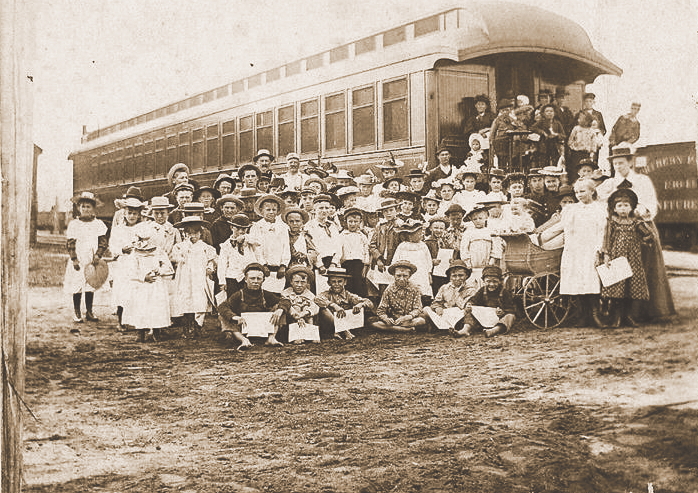
Trains carried groups of 10 to 100, supervised by two or three adults who enforced discipline during the three- to four-day trips.
Stops occurred in predetermined towns across 45 states, with the Midwest receiving the bulk; Kansas, for example, took in over 5,000 children between 1867 and 1930, according to state archives.
In many instances, placements resembled auctions more than adoptions.
Local committees assembled crowds in opera houses or train stations, where children stood on platforms for inspection.
Families evaluated them based on strength for farm work or demeanor for household help, sometimes poking at muscles or checking teeth as one would livestock.
Contracts stipulated that boys would learn trades until age 21, receiving $100 upon maturity, while girls focused on domestic skills.
Legal adoption was optional, leading to indenture arrangements in about 30 percent of cases, per a 1910 Children’s Aid Society survey.
Siblings often separated, with records showing over 10,000 such divisions to maximize placement rates.
For non-English speakers, primarily from Irish, Italian, or German immigrant families comprising 75 percent of riders, agents sought compatible homes to ease transitions.
Outcomes varied widely, painting a complex picture of 19th century child welfare practices.
A 1910 internal review by the Children’s Aid Society claimed 87 percent of placements succeeded, with children integrating as productive citizens, while 8 percent returned east and 5 percent faced arrest or disappearance.
Success stories abound among notable figures. Andrew Horace Burke, sent from New York in 1864 at age 12, worked on Indiana farms before rising to become North Dakota’s second governor from 1891 to 1893, advocating for education reforms.
His childhood friend from the same train, John Green Brady, advanced to govern the Alaska Territory from 1897 to 1906, establishing schools and supporting Native rights.
Other riders included Scott Rains, who became a Kansas Supreme Court justice, and eden ahbez, the bohemian songwriter behind the 1948 hit “Nature Boy” recorded by Nat King Cole.
Inventors like George Anthony Dondero, a Michigan congressman, and professionals such as bankers and physicians emerged from the program, demonstrating its potential for upward mobility in an era when only 2 percent of Americans attended college.
Yet darker experiences underscore the movement’s flaws.
Investigations in the 1880s, including Minnesota’s 1883 report on 1,500 placements, revealed hasty decisions and exploitation, with 20 percent of children enduring physical abuse or overwork.
Lee Nailling, placed in Texas at age nine after his mother’s death in 1901, recalled beatings and hunger on a farm where he labored from dawn to dusk without schooling.
Alice Ayler Bullis, sent from New York in 1913 at age 11, described surviving on wild berries before her placement, only to face isolation in a Nebraska home that treated her as unpaid help.
Racial tensions flared in a 1904 Arizona incident, where 40 Irish children placed with Mexican families were forcibly removed by white vigilantes, leading to a Supreme Court ruling upholding the abductions on grounds of “racial fitness.”
Critics, including Catholic leaders, accused Protestant agencies of cultural erasure, as name changes affected up to 40 percent of riders, severing ties to heritage.
As the 20th century progressed, opposition mounted.
Midwestern states enacted laws requiring bonds for out-of-state children; Michigan’s 1895 statute demanded $500 per child to cover potential public charges.
By 1920, improved urban social services, including mothers’ pensions reaching 200,000 families nationwide, reduced the need for relocation.
The Dust Bowl’s agricultural devastation, displacing 2.5 million people in the 1930s, further strained rural economies, eliminating demand for extra labor.
The last official train departed in 1929, though informal placements lingered into the 1930s.
The program’s influence reshaped American adoption and foster care systems, shifting emphasis from institutions to family-based care, a model that by 1940 saw 70 percent of dependent children in homes rather than asylums.
Descendants, numbering in the millions today, preserve memories through organizations like the Orphan Train Heritage Society of America, founded in 1986 with over 500 members dedicated to genealogy research.
Museums such as the National Orphan Train Complex in Concordia, Kansas, housed in a 1917 Union Pacific depot listed on the National Register of Historic Places since 2000, archive over 3,000 rider files and host annual gatherings attended by hundreds.
In Louisiana, the Opelousas museum, opened in 2009, displays artifacts from the 273 children placed there between 1907 and 1929, highlighting Southern integrations.
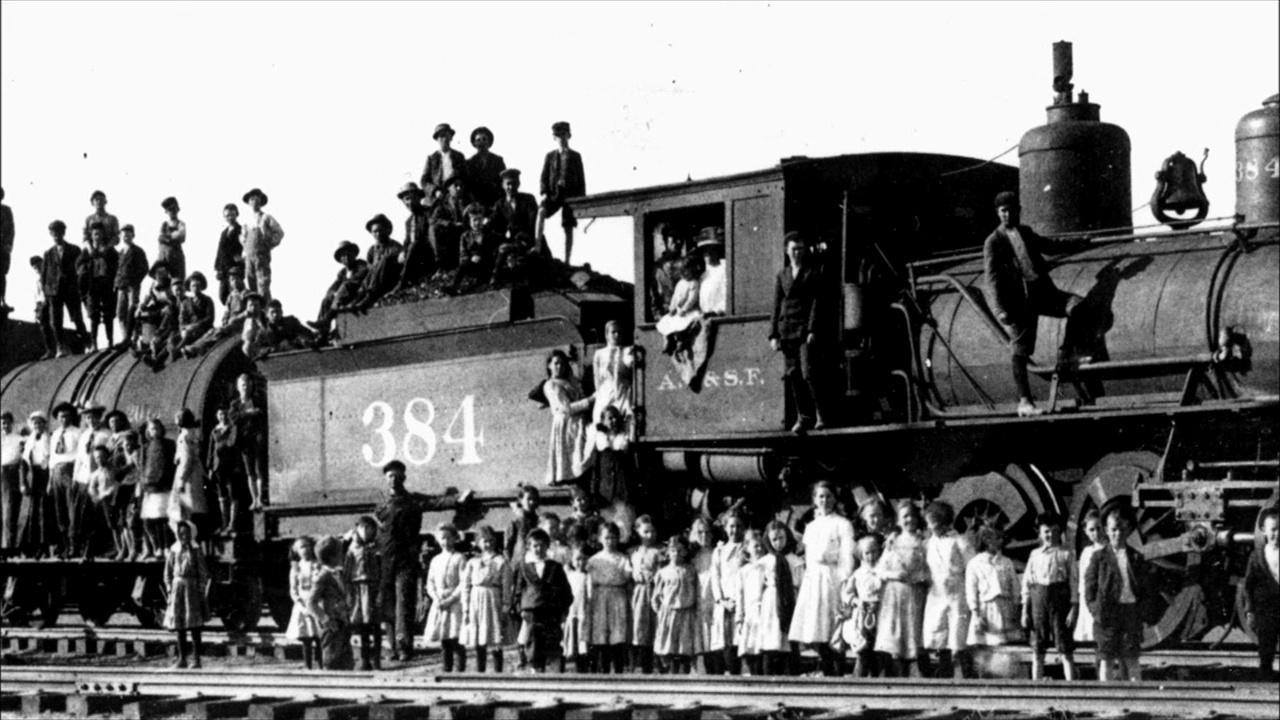
Cultural depictions keep the era alive. Christina Baker Kline’s 2013 novel “Orphan Train,” a New York Times bestseller with over 3 million copies sold, weaves fictional narratives with historical accounts, inspiring adaptations like a 2017 stage play.
Documentaries such as PBS’s “The Orphan Trains” from 1995, viewed by millions, feature survivor interviews, while songs like Utah Phillips’ “Orphan Train” evoke the loneliness of the journeys.
These works prompt reflection on how child relocation programs echoed Native American removals, both justified as civilizing missions yet fracturing communities.
Hidden records continue to surface, with DNA testing reuniting families separated for generations; in 2018, Ancestry.com partnered with the National Orphan Train Complex to digitize 10,000 placement documents, uncovering links for over 1,000 users annually.
What other untold accounts lie in attics or archives, waiting to reveal the full scope of this chapter in historical adoption?
And how do echoes of these practices persist in today’s debates over child welfare and immigration policies?