
Trump Invokes Wartime Powers to Boost Domestic Critical Mineral Production, Citing National Security
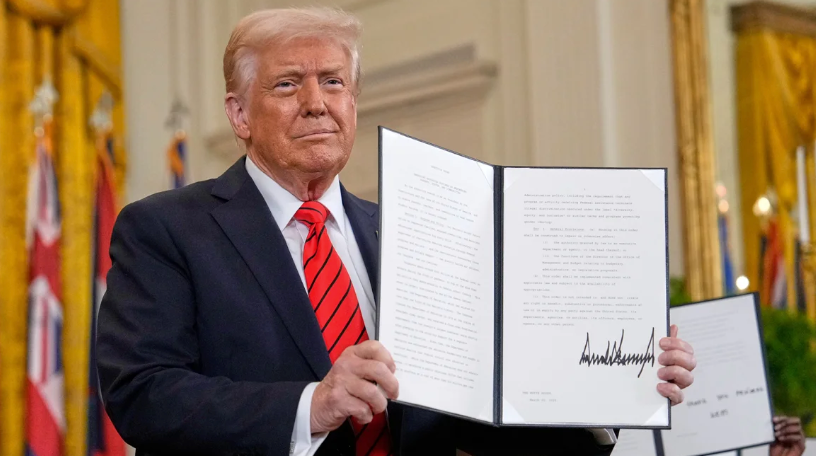
WASHINGTON, D.C. — President Donald Trump signed an executive order Thursday invoking the Defense Production Act (DPA) to accelerate the leasing and development of federal lands for mining critical minerals, including uranium, copper, potash, and gold, in a bid to reduce U.S. reliance on foreign suppliers like China.
The order, framed as a national security imperative, directs federal agencies to prioritize mineral extraction projects and fast-track permitting processes.
It marks Trump’s latest effort to position domestic resource production as a cornerstone of his “America First” agenda, while escalating economic tensions with Beijing.
Wartime Law Revived for Minerals
The DPA, a 1950s-era law last used by Trump during the COVID-19 pandemic to mobilize medical supply chains, grants the government emergency authority to steer industrial production.
Under the order, Defense Secretary Pete Hegseth will oversee its implementation, coordinating with cabinet officials to “expedite priority mineral production projects” that can be “immediately approved.”
“It is imperative for our national security that the United States take immediate action to facilitate domestic mineral production to the maximum possible extent,” the order states, emphasizing vulnerabilities in supply chains dominated by geopolitical rivals.
Interior Secretary Doug Burgum has 10 days to catalog federal lands holding mineral deposits and designate mining as their “primary land use.”
Agencies, including Energy, Agriculture, and Defense, must also identify sites for private mineral production.
China’s Stranglehold and Retaliatory Measures
The move directly challenges China, which controls over 50% of global processing for minerals critical to defense, clean energy, and technology, according to the U.S. Geological Survey (USGS).
In 2024, the U.S. imported more than half its supply of yttrium, bismuth, antimony, arsenic, and rare earths from China.
Beijing has weaponized its dominance in recent years, restricting exports of gallium, germanium, and lithium extraction technology—key for semiconductors and electric vehicles (EVs)—in retaliation for U.S. tariffs and semiconductor export controls.
Earlier this year, China imposed curbs on tungsten, tellurium, and molybdenum after Trump announced a 10% tariff on Chinese imports.
“By encouraging streamlined permitting and financing support, we can finally challenge China’s mineral extortion,” said Rich Nolan, CEO of the National Mining Association, praising the order as a “national security imperative.”
Bipartisan Goals, Divergent Approaches
While boosting domestic mineral production has bipartisan support, Trump’s approach contrasts with his predecessor’s.
President Joe Biden invoked the DPA in 2022 to bolster critical mineral supply chains under his climate agenda, pairing it with clean energy tax incentives.
His administration greenlit several mining projects but faced pushback from environmental groups.
Trump’s order, however, ties mineral expansion to a broader energy dominance strategy.
On Inauguration Day, he declared a “national energy emergency,” blaming foreign actors for “diminished capacity to insulate” Americans from price spikes.
Ukraine Deal in Limbo
The White House also teased a pending rare earth minerals agreement with Ukraine, which Trump said would be signed “very shortly.”
The deal, discussed during Ukrainian President Volodymyr Zelensky’s tense Oval Office meeting last month, stalled amid disagreements over terms.
Details remain unclear, but the pact could offer Ukraine economic relief as it navigates Trump’s demands for increased defense spending.
Environmental and Practical Hurdles
Critics warn that expediting mining on federal lands risks environmental damage and legal challenges.
The order does not override existing environmental reviews, but its emphasis on speed may test regulatory frameworks.
Meanwhile, industry analysts question whether the U.S. can rapidly scale processing capabilities, given China’s decades-long head start.
As geopolitical rivalries intensify, the race to secure critical minerals—the backbone of modern technology—has become a 21st-century battleground.
Trump’s order signals a wartime footing in this struggle, with domestic production now squarely in the crosshairs.