The $50 brooch Queen Elizabeth wore: Obama’s 70-year diplomacy lesson
- A modest American brooch became one of the most memorable symbols of Queen Elizabeth II’s quiet diplomacy.
- Michelle Obama reportedly worried the gift was too humble for a monarch surrounded by priceless royal jewels.
- The Queen answered without a speech, wearing it the very next evening at Winfield House.
In a royal collection running to more than one million objects, one small American brooch, reportedly worth only $50, managed to carry a message that grander gifts could not.
It was not the gold, the diamonds, or the moss agate that made it memorable. It was where Queen Elizabeth II chose to wear it, and when.
A Small Gift Inside a Palace Built for Grandeur
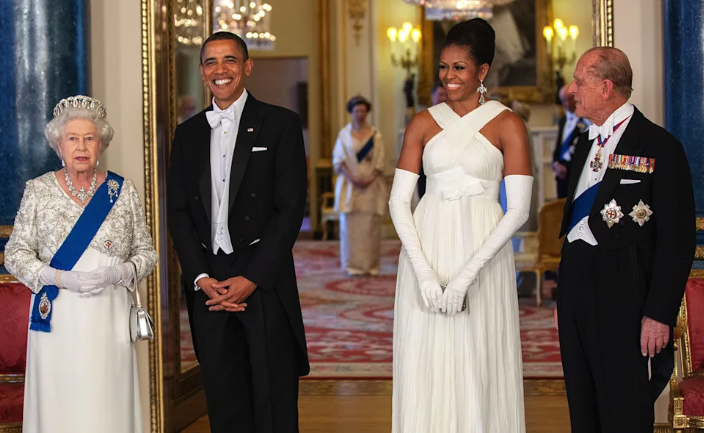
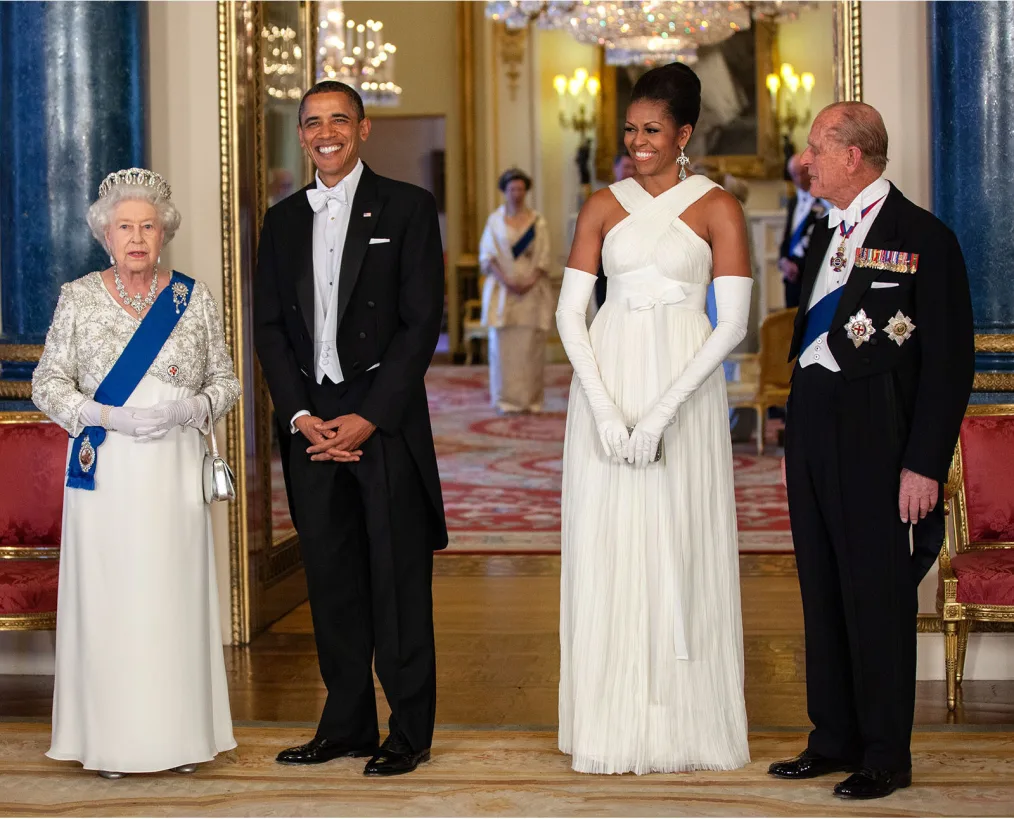
When President Barack Obama and First Lady Michelle Obama arrived in Britain in May 2011, the visit carried the full weight of diplomatic theater.
It was a state visit from May 24 to 26, made at the invitation of Queen Elizabeth II, with the President and Mrs. Obama staying at Buckingham Palace.
For most guests, Buckingham Palace is not simply a residence. It is a living stage of monarchy.
The guards, the banquet table, the royal procession, the ancient silver, the music, the palace rooms, and the presence of a monarch who had already spent nearly six decades on the throne all turned the visit into a moment of international prestige.
Obama was not just any visitor. He was the 44th president of the United States, the first African American president, and by 2011 a global political figure whose speeches, diplomacy, and symbolism were watched far beyond Washington.
Michelle Obama, born in Chicago and educated at Princeton and Harvard Law School, had become one of the most visible first ladies in modern American history, known for public health, military family support, education, and girls’ opportunity initiatives.
But inside that grand setting, the emotional center of the story was not a speech, a treaty, or a banquet toast. It was a brooch.
The formal gift from the Obamas to the Queen was not actually the brooch.
According to the official royal state visit programme, President and Mrs. Obama gave Queen Elizabeth II a leather-bound album containing rare memorabilia and photographs chronicling the 1939 United States visit of her parents, King George VI and Queen Elizabeth.
That was a carefully chosen diplomatic gift, rooted in history and family memory. The 1939 royal visit had been the first by a reigning British monarch to the United States, and it came at a tense moment before the Second World War.
The brooch was different. It was personal.
Reports later described the piece as a vintage floral brooch made with 14-karat yellow gold, diamonds, and moss agate, hand-picked from Tiny Jewel Box in Washington, D.C.
It was elegant, but not imperial. It was American, but not loud. It carried the personality of Michelle Obama’s choice rather than the machinery of state.
That was why it worried her.
Michelle Obama’s Private Anxiety
The Queen owned, wore, and inherited jewelry connected to centuries of royal history.
Her collection included tiaras, pearls, brooches, diamonds, and diplomatic jewels that had appeared at coronations, banquets, tours, and state openings.
Against that background, a modest American antique could seem dangerously small.
Years later, Barack Obama remembered that Michelle had selected a “small, modest brooch of nominal value,” and that the scale of the state dinner made the gift feel almost inadequate.
That nervousness made sense. A state visit is filled with protocol. Every gesture is read. Every dress, seating plan, menu, and gift carries meaning.
The Obamas were not only representing themselves. They were representing the United States, its history, its manners, and its understanding of monarchy.
Yet the gift was given.
The next evening, the roles reversed. After the Queen hosted the Obamas at Buckingham Palace, President and Mrs. Obama hosted Queen Elizabeth II and Prince Philip at Winfield House, the official residence of the U.S. ambassador in London.
The Obama Foundation later described that 2011 sequence clearly: the Queen hosted the state banquet at Buckingham Palace, and the following night the Obamas hosted dinner for the Queen at Winfield House.
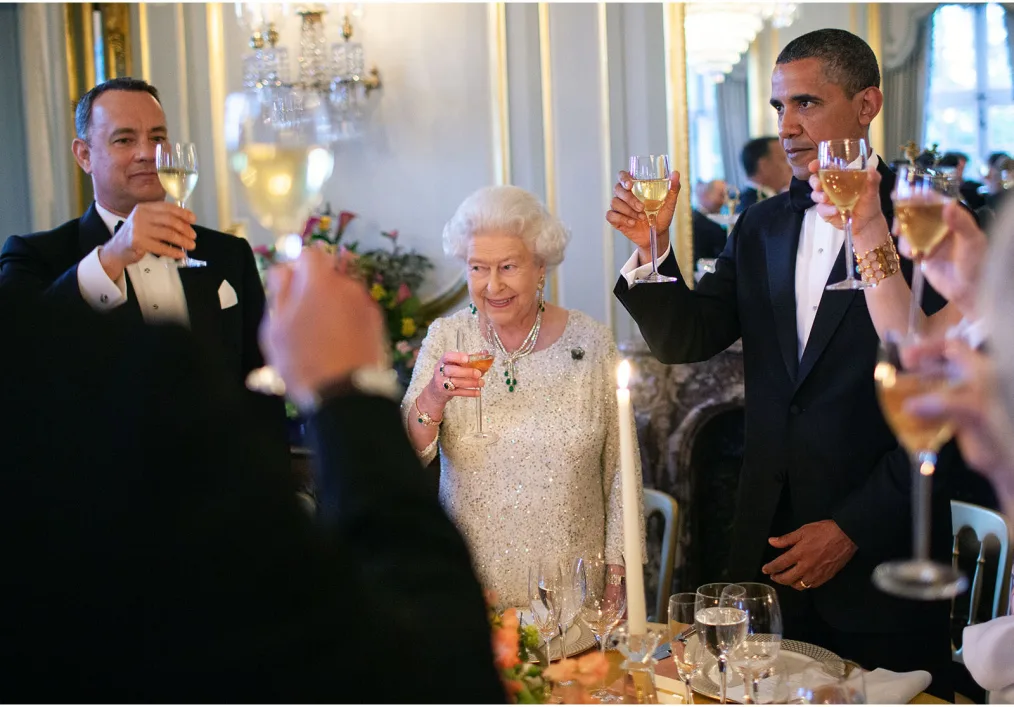
When Queen Elizabeth arrived, the Obamas noticed the detail immediately.
She was wearing the brooch.
The woman who could have selected a diamond piece from one of the world’s most famous royal jewelry collections chose the small American gift from Michelle Obama.
She wore it not months later, not privately, not as a forgotten courtesy, but the very next night, in front of the people who had given it to her.
That was the genius of the gesture. It needed no announcement. It did not embarrass the giver with praise.
It did not turn sentiment into performance. It simply said, with the silent language of royal dressing, “I saw your thoughtfulness.”
Obama later described the moment as an example of the Queen’s subtle thoughtfulness, not only toward them but toward everyone she met.
The Queen’s Gift in Return
The exchange had another quiet layer. The Queen and Prince Philip gave Michelle Obama an antique brooch of their own, shaped like a rose and made of gold and red coral, presented in a red leather jewel box.
That detail matters because the rose is deeply tied to English symbolism.
The gesture turned the exchange into something personal between two women occupying public roles under intense scrutiny. Michelle brought an American antique into the palace.
Elizabeth gave her a rose-shaped piece linked to British identity. In a world of flags, guards, and speeches, the two women exchanged something intimate enough to be worn close to the heart.
The state visit itself was packed with historic detail.
The official programme recorded a ceremonial arrival, a meeting with the Duke and Duchess of Cambridge, an exchange of gifts, a state banquet, speeches, and a dinner at Winfield House.
It also noted gun salutes of 41 guns in Green Park and 62 guns at the Tower of London.
Those numbers reveal the scale of the occasion. But the memory that lasted was smaller than a medal and quieter than a toast.
A Relationship That Began Before the Brooch
The 2011 brooch moment did not appear out of nowhere. Barack and Michelle Obama had first met Queen Elizabeth II in 2009, shortly after Obama entered the White House.
Michelle later recalled feeling nervous because she had never met royalty before, yet said the Queen quickly made the moment feel natural, describing her as warm, kind, personable, and funny.
That first meeting became famous for a very human reason.
Michelle Obama placed an arm around the Queen during a reception, a gesture widely discussed as a breach of royal protocol.
But the story endured because it showed something more interesting than etiquette. The Queen did not appear offended.
Instead, what could have been treated as a scandal softened into a moment of connection.
This is where Elizabeth II’s biography becomes important.
She was born in 1926, became Queen in 1952, and reigned for more than 70 years, making her Britain’s longest-reigning monarch.
She died on September 8, 2022, at the age of 96.
Across that reign, she met presidents, prime ministers, generals, popes, astronauts, schoolchildren, and ordinary citizens.
The official 2011 state visit programme listed a long history of American presidential encounters, including Eisenhower, Kennedy, Nixon, Carter, Reagan, George H.W. Bush, Clinton, George W. Bush, and Obama.
It also noted that the Queen and Prince Philip had made four state visits to the United States.
Her public life was built on repetition. Handshakes. Walkabouts. Banquets. Speeches.
Openings. Tours. Audiences. Yet the brooch story shows why people remembered her not only as an institution, but as a person.
Why Jewelry Became a Language
Queen Elizabeth II understood that clothing and jewelry were not decorative details. They were tools of public communication.
A bright coat could make her visible in a crowd. A brooch could acknowledge a country, a memory, a family connection, or a diplomatic relationship.
That is why the American brooch mattered so much. It was not merely worn. It was placed into context.
Coverage in later years referred to the jewel as the “American State Visit Brooch,” describing it as a small green flower and noting that the Queen wore it during the Obamas’ reciprocal dinner at Winfield House.
The same brooch drew attention again in July 2018, when Queen Elizabeth wore it during an audience at Windsor Castle on the day President Donald Trump arrived in Britain.
Speculation followed, as it often did whenever the Queen chose a notable brooch.
But even without reading politics into the later appearance, the jewel’s history was already powerful.
It had become associated with one of the warmest modern relationships between the British monarch and an American presidential family.
The Last Visit: Windsor, 2016
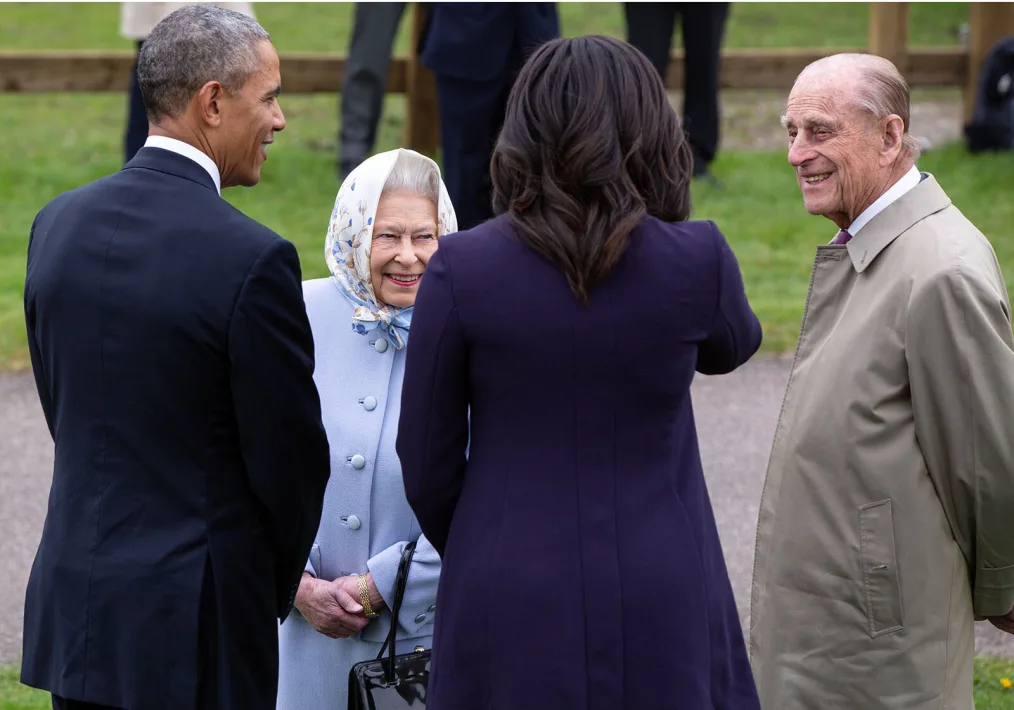
The Obamas’ final visit with Queen Elizabeth II while Barack Obama was president came in April 2016, around the Queen’s 90th birthday.
The Obama Foundation notes that this final in-office visit coincided with that milestone, and Obama publicly called the Queen one of his favorite people.
That statement carried unusual warmth for diplomatic language. Presidents often praise monarchs politely.
They speak of alliances, shared sacrifice, military partnership, democratic values, and the so-called special relationship between the United States and the United Kingdom.
Obama did all of that. But when he spoke of Elizabeth, he also sounded personal.
The Queen’s feeling reportedly went both ways.
A later account cited a former royal employee who said Queen Elizabeth had a soft spot for Americans after meeting Obama and had asked whether he could visit Britain again even after leaving office.
Whether expressed publicly or privately, the relationship stood out because it seemed to cross the boundary between official duty and human affection.
Obama saw in the Queen a quality he associated with his grandmother, Madelyn Dunham, who helped raise him.
In his 2022 tribute, he remembered the Queen as gracious, no-nonsense, humorous, curious, and deeply considerate.
The Tribute After Her Death
When Queen Elizabeth II died in 2022, the world measured her life in historic numbers: 70 years on the throne, 15 British prime ministers, 96 years of life, and a reign that stretched from the age of Winston Churchill to the age of smartphones.
But Barack Obama’s tribute returned to something smaller.
He remembered the brooch.
He remembered that Michelle had worried about the modest gift. He remembered the next night at Winfield House.
He remembered seeing the Queen wearing it. And in that memory, the public life of a monarch became understandable through a private act of kindness.
That is why the story continues to move readers. It is not really about luxury jewelry, royal protocol, or presidential access.
It is about emotional intelligence at the highest level of public life. Queen Elizabeth II knew that Michelle Obama had not merely purchased a brooch.
She had chosen it. She had worried over it. She had offered it across a divide of tradition, history, race, nationality, and rank.
The Queen’s response was to wear it.
No official statement could have improved the gesture. No press release could have made it warmer. No grander jewel could have said more.
In the end, the small American brooch did what the best diplomatic gifts are supposed to do.
It carried the giver’s identity, entered the receiver’s world, and came back as a message.
A gift once feared too humble for Buckingham Palace became unforgettable because Queen Elizabeth II understood that the value of a thing is sometimes revealed only when someone powerful chooses to honor it.