Ndakasi and Andre Bauma: The 14-Year Bond Born From Virunga’s 2007 Violence
- Ndakasi was about two months old when armed violence killed her mother in Virunga National Park in June 2007.
- Ranger Andre Bauma kept the dehydrated infant warm through a rain-soaked night, beginning a relationship that lasted the rest of her life.
- Her life unfolded during a major recovery in mountain gorilla numbers, even as war, disease, poaching and habitat pressure continued to threaten the species.
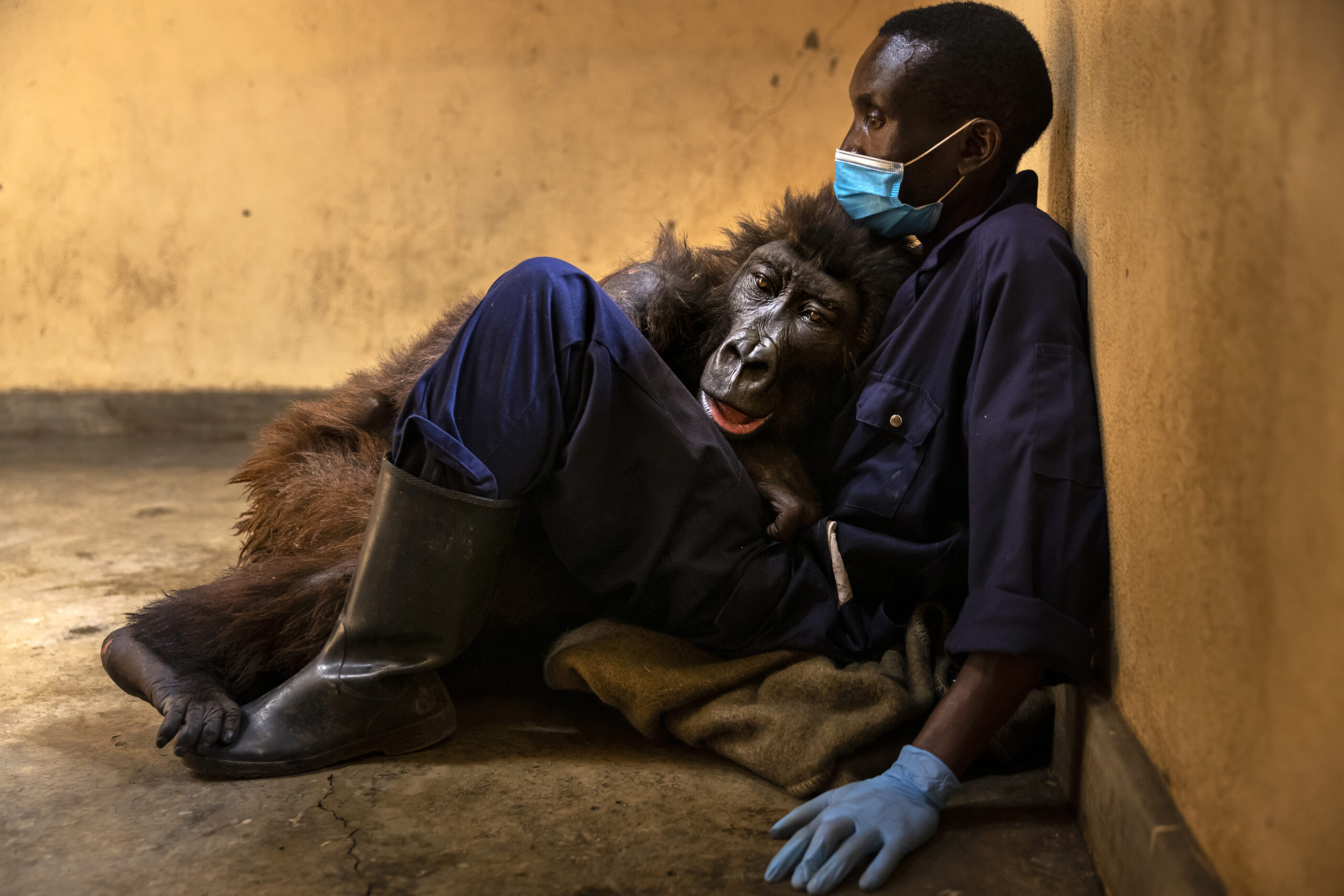
The photograph that closed Ndakasi’s life looked almost like a reversal of the night that had opened her second chance.
In September 2021, the full-grown mountain gorilla leaned into Andre Bauma at the Senkwekwe Center in Virunga National Park.
Fourteen years earlier, she had been small enough for Bauma to hold against his bare chest while rain fell around them and rangers tried to keep her alive.
That symmetry made the final image travel around the world. The years between those two embraces tell a larger story.
Ndakasi’s life was shaped by armed conflict, emergency veterinary medicine, the unusual demands of raising an orphaned mountain gorilla, and a conservation effort that had to continue while eastern Congo remained one of the most dangerous places in the world to protect wildlife.
The Gunshot That Left a Two-Month-Old Gorilla Alone
Ndakasi was born into the Kabirizi group in Virunga National Park in April 2007.
Her mother, Nyiransekuye, lived in the park’s mountain gorilla sector near the chain of volcanoes that crosses the borders of the Democratic Republic of the Congo, Rwanda and Uganda.
The infant’s first weeks coincided with a dangerous period for both the gorillas and the people assigned to protect them.
On June 8, 2007, a female mountain gorilla in Virunga’s southern sector was shot at close range.
UNESCO reported that her young baby was found with the body and warned that the killing followed the deaths of two male gorillas earlier that year.
The victim was Nyiransekuye, and the infant was Ndakasi. The 2007 UNESCO account shows how quickly a single animal’s rescue became part of a wider conservation emergency.
Gorilla Doctors later recorded that Ndakasi was found clinging to her mother in June and was too young to survive without milk and constant care.
She was weak, frightened and dehydrated. Rangers and veterinarians decided to intervene, even though removing a wild gorilla from its family is normally a last resort.
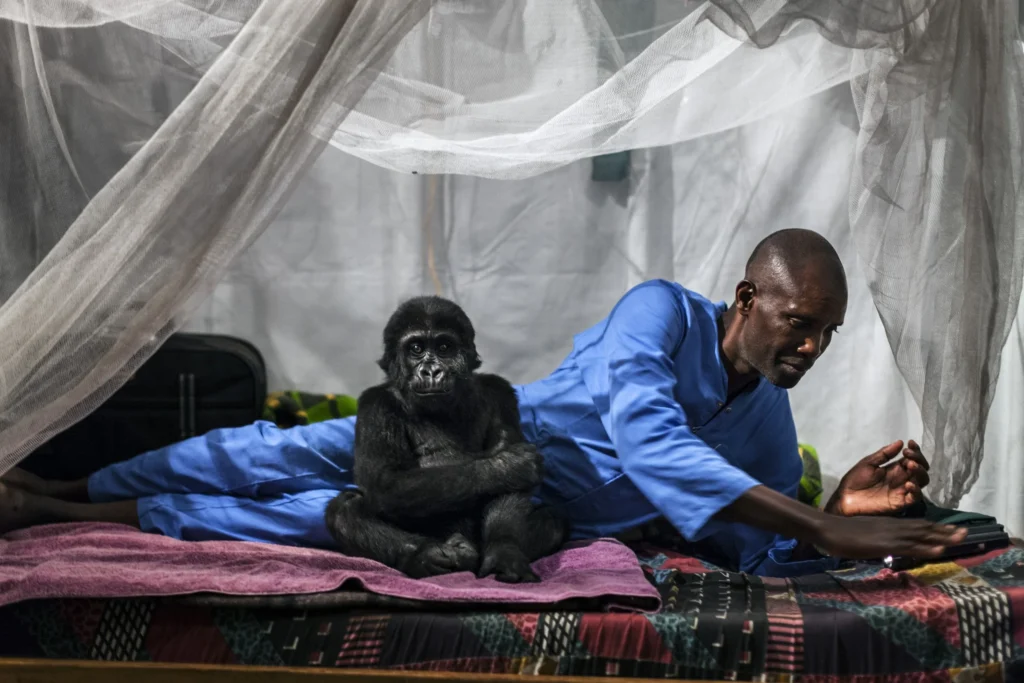
Bauma became the person responsible for getting her through the first night. Virunga’s later account says a torrential storm continued while he kept the infant pressed against his chest for warmth.
Gorilla Doctors has also described him dabbing milk on her gums and tongue because dehydration posed an immediate danger.
He slept with her close to his body and carried her when she lacked the strength to move normally.
Survival that night did not end the crisis. Ndakasi was taken to temporary care in Goma, where she developed severe pneumonia as an infant.
Veterinarians placed her in a makeshift oxygen tent and treated her around the clock.
Human care had saved her, but the same dependence meant that returning her to a wild gorilla family became increasingly difficult.
A Rescue That Happened in the Middle of a Larger Killing
Ndakasi’s mother was not the only mountain gorilla killed in Virunga in 2007. The violence continued into July, when members of the Rugendo group were shot.
Among the dead were the group’s silverback Senkwekwe and the adult female Safari. Safari’s infant, Ndeze, survived and also required human care.
The two orphans came from separate attacks, a detail that is often lost when the events are retold as one massacre.
Gorilla Doctors’ contemporary records distinguish the June attack on the Kabirizi group from the July killings in the Rugendo group.
By the end of 2007, UNESCO said ten gorillas had been killed in Virunga that year, two more were missing, and fighting had kept park authorities out of the gorilla sector for more than three months.
The security crisis extended far beyond wildlife. In December 2007, UNESCO estimated that renewed fighting around North Kivu had displaced about 425,000 people, including park staff.
Rangers were trying to protect animals inside a landscape where armed groups, illegal resource extraction and human displacement could change the situation from week to week.
Ndakasi and Ndeze spent their early years in Goma. In 2009, after park staff regained control of the southern sector, Virunga opened the Senkwekwe Center at its headquarters in Rumangabo.
It became the only facility devoted specifically to orphaned mountain gorillas. Gorilla Doctors documented the transfer of Ndakasi and Ndeze from Goma to the new center, where they could live in a forested setting rather than a cramped urban compound.
What Fourteen Years of Care Actually Required
Bauma’s relationship with Ndakasi became the emotional center of her story, but keeping her healthy depended on a team.
Senkwekwe’s caretakers, veterinarians and support staff provided food, medical treatment, social contact and a controlled environment for animals that could no longer be returned safely to the wild.
The work was unusually intimate. Caregivers spent long periods with the orphans, sometimes sleeping near them and structuring daily routines around feeding, exercise and observation.
Photographer Brent Stirton later wrote that some caretakers spent more time with the gorillas than with their own families.
Bauma brought his own children to meet the orphans and referred to the gorillas as their brothers and sisters.
Ndakasi also needed repeated medical intervention. In 2011 she suffered a serious concussion after falling from a tall tree.
Later that year, a gastrointestinal infection left her weak and undernourished. During a later examination, veterinarians treated oral lesions that suggested a viral infection.
She weighed 59.8 kilograms, about 132 pounds, at that checkup. The veterinary record of those illnesses gives a clearer picture of what long-term sanctuary care meant than the famous photographs alone can provide.
Her recovery from those episodes allowed her to grow into a strong adult. The frightened infant of 2007 became playful, socially confident and familiar with the people around her.
That change came slowly, through years of routine rather than a single dramatic rescue.

The Selfie That Made Ndakasi Famous Outside Virunga
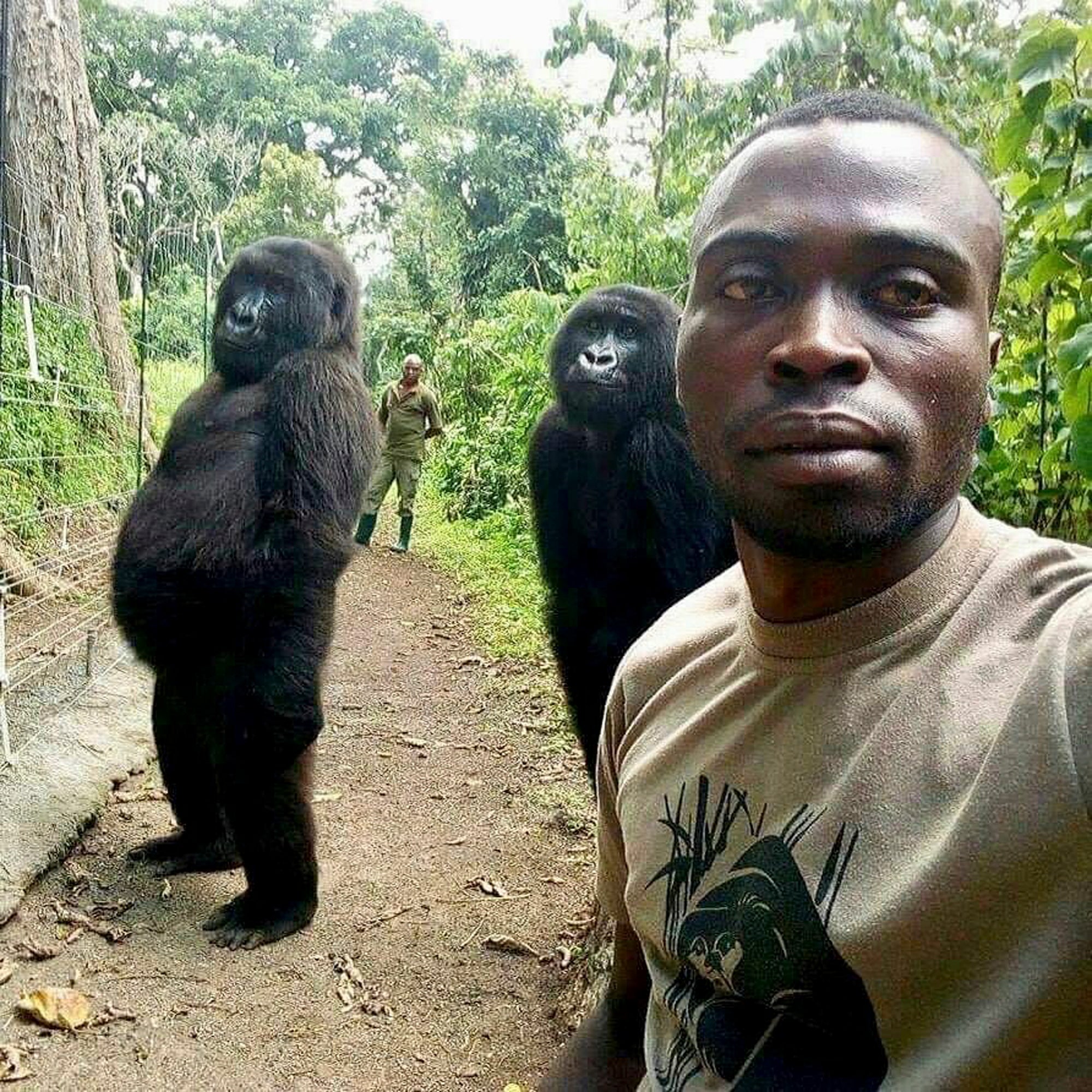
On April 18, 2019, ranger Mathieu Shamavu took a photograph at Senkwekwe that changed the scale of Ndakasi’s public fame.
Shamavu stood close to the camera while Ndakasi and Ndeze appeared behind him, upright on two legs and looking directly toward the lens. Another ranger could be seen farther back.
The image spread rapidly online around Earth Day. Its humor came from the gorillas’ posture and the strangely familiar look of the scene.
Virunga confirmed that the photograph was real and explained that the two orphans were comfortable standing upright for short periods.
They had also spent their lives around human caregivers, so a relaxed pose near rangers was not unusual inside the center.
The photograph was sometimes described later as Andre Bauma’s selfie. It was Shamavu who took it.
Bauma’s role in Ndakasi’s life was much longer and quieter. By the time the picture went viral, he had already spent more than a decade participating in the daily care that made such a relaxed moment possible.
Ndakasi Lived Through a Rare Conservation Recovery
When Ndakasi was born, mountain gorillas were still classified as Critically Endangered.
Their habitat was restricted to two small regions, and the animals faced poaching, disease, habitat loss and recurring armed conflict.
The events of 2007 showed how quickly a few killings could matter when the total population was so small.
Yet the population increased during Ndakasi’s lifetime. In 2018, the International Union for Conservation of Nature moved the mountain gorilla from Critically Endangered to Endangered.
The IUCN cited intensive protection, anti-poaching patrols and veterinary interventions among the measures that helped push the estimated population from about 680 animals in 2008 to more than 1,000 a decade later.
The change did not mean the species was safe. It meant sustained protection had produced measurable results under difficult conditions.
Virunga later calculated that the global mountain gorilla population had risen from about 720 in 2007 to an estimated 1,063 in 2021.
Ndakasi herself never returned to the forest as a wild gorilla. Her life at Senkwekwe belonged to another part of the same conservation system: what happens when protection fails, an infant survives, and people must assume responsibility for the rest of that animal’s life.
When Her Strength Began to Fail
In 2021, Ndakasi developed a prolonged illness. Virunga did not publicly identify a precise cause in its announcement.
The park said her condition deteriorated rapidly near the end. By then Bauma was chief caretaker at Senkwekwe and had known her for almost her entire life.
Brent Stirton, who had photographed Ndakasi across many years, returned to record her final period.
His images show the practical side of care as well as its emotional cost: gloves, masks, bare concrete, blankets, close observation and the physical presence of people who had spent years learning her habits.
On September 26, 2021, Ndakasi moved close to Bauma and rested against him.
Virunga said she took her final breath in the arms of her “caretaker and lifelong friend.” Bauma later said he was proud to have called her his friend and that he had loved her like a child.
The final photograph by Stirton became one of the most widely seen images from Ndakasi’s life.
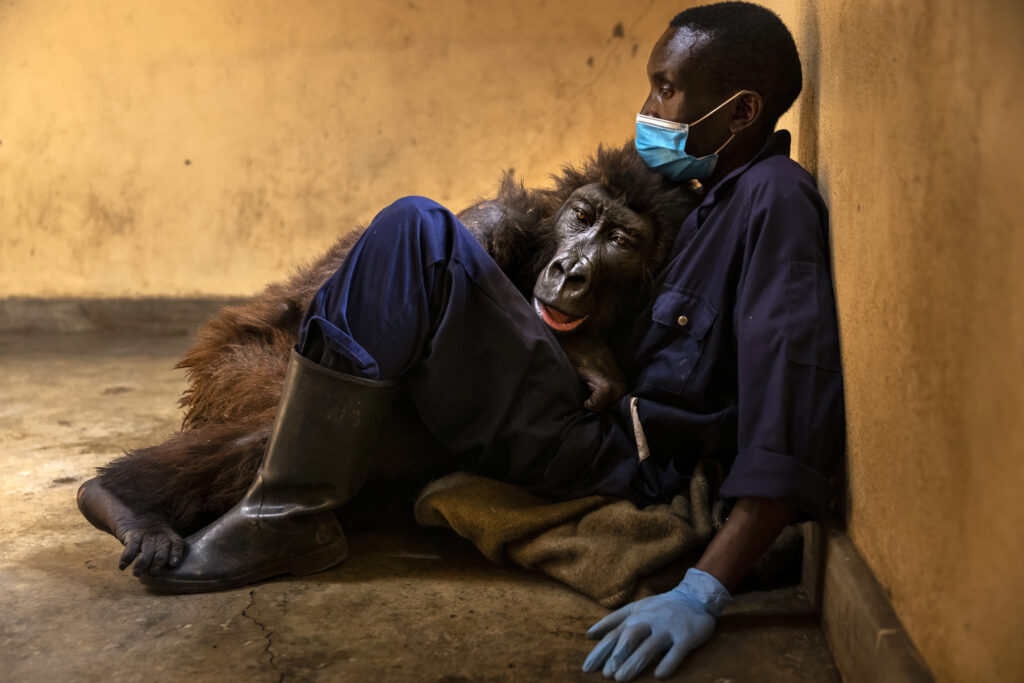
In 2022, the Natural History Museum’s Wildlife Photographer of the Year competition named “Ndakasi’s passing” the winner of its photojournalism category.
The picture carried unusual force because it recorded the end of a relationship that had begun with another act of physical shelter.
In June 2007, Bauma had held a dehydrated infant close because her body could not retain enough warmth to survive the night.
Fourteen years later, when medicine could no longer reverse her decline, Ndakasi again settled against the person whose presence had been familiar since the first hours after her rescue.
The last image did not create their bond. It showed what fourteen years of care had made possible.